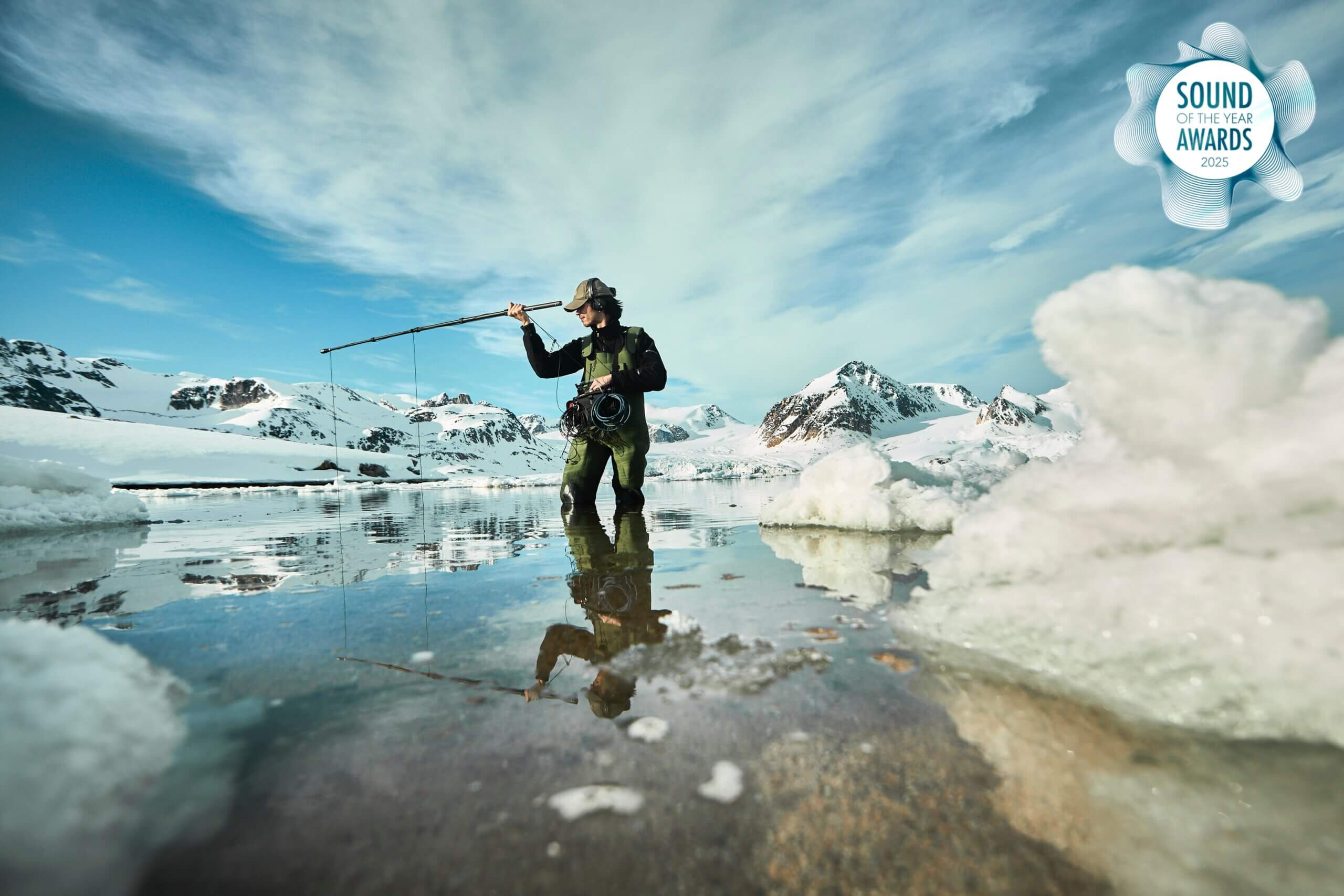
Songs of the Bearded Seals | sound piece in stereo (4min43), raw field recording made with two hydrophones | Winning Submission of the 2025 Sound of Year Awards
“During a violent and politically volatile year, there is something particularly poignant about listening instead to other mammals we share this planet with. At a time when action on the climate crisis and peace is more urgent than ever, hearing the extraordinary songs of other living beings helps us recognise our responsibilities to other species as well as our own.” — Matthew Herbert Chair of Judges of 2025 edition of the Sound of Year Awards
Listen to Songs of the Bearded Seals on SOTYA’s website by clicking here.
On May 24, 2025, I reached my northernmost point, at 80° 37.26′ N 014° 01.63′ E, a day in the ever-changing world of the Arctic Ocean’s sea ice. A space in perpetual motion, with floating and drifting ice, a habitat for polar animals, a place to admire, to linger in, an unforgettable setting for a visit, a place not meant for us, where humans are merely visitors, and sometimes listeners.
For a few hours, I dipped my hydrophones into these northern waters, stationary in the cold weather, lulled by the subtle, tinkling rhythm of the brash ice and the powerful voices of the bearded seals surrounding us underwater. Their spiralling long trills, short sweep calls and low frequency moans are one of the most otherworldly sounds I’ve ever heard in the field, whose magnetism strangely connected me to their sentient reality on a deeper level. I still wonder why I felt such an affinity with their voices, perhaps it is because we share the same respiratory anatomy as mammals, each with a mouth, a larynx, a trachea and lungs.
Later in the Southern lands, I read that these vocalisations are apparently only heard during the breeding season, which lasts around 90 days, from late March to mid-July. It is likely that the duration of the trill indicates territorial ownership and social rank among the males. Bearded seals have a unique adaptation, an elastic airway that they’d inflate during their call. This structure resonates and radiates their vocalisation much like a fishes swim bladder, but it’s not clear how the sound starts. Muscles can’t flex fast enough to create the high frequencies of these calls and without exhaling air can’t pass through the larynx across the vocal cords, as it does when seals bark at the surface. They probably cycle air back and forth to the lungs, but it isn’t clear what structure turns that airflow into sound.
This in-situ listening experience will remain anchored in my memory forever, where the voices of the bearded seals still echo in the depth of my cochlea, prolonging this sensorial reality of the Arctic world’s fragility. Within the emotional after-images of this remote place fading, I still wonder how listening might preserve a fleeting trace of what once was.
Press
[radio], ENG, with Matthew Herbert at Today (28th May 2026), BBC Radio 4
[interview], FR, article written by François Mauger, Le Français Mathias Arrignon remporte le « Sound of the Year Award », 4’33 Magazine
[review], FR, review written by François Mauger, La Note Verte, AR Magazine 75
[radio + interview], ENG, with Mark Stephen and Rachel Stewart at Out of Doors (6th June 2026), BBC Radio Scotland